Sourdough Pullman Loaf
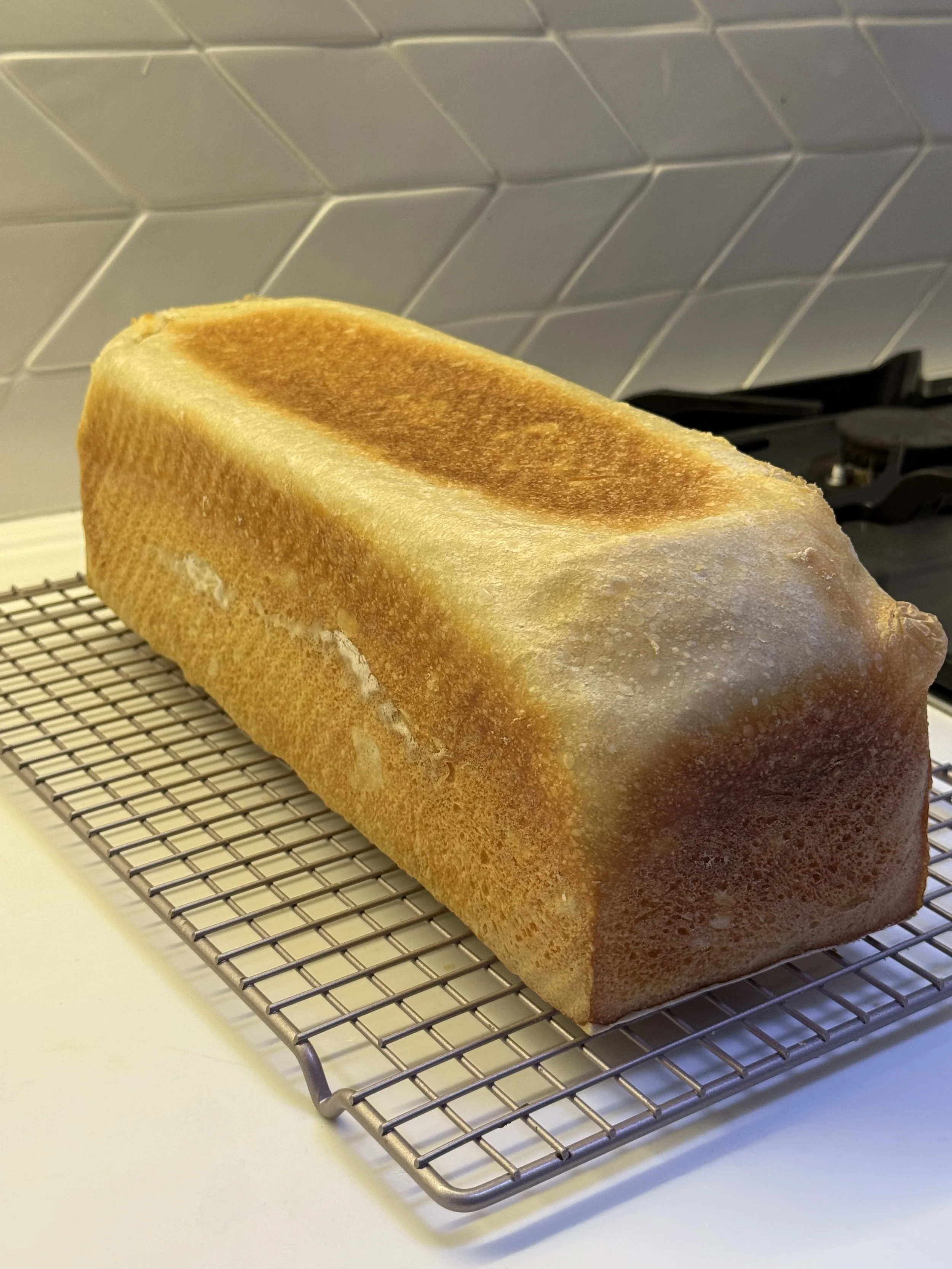
It's been years since I bought a loaf of bread. Once you know what goes into a supermarket loaf, the gums, the additives, the preservatives, it's pretty hard to go back. Most weeks I'm making a country sourdough, but there's something about a square sandwich loaf that I've always missed. Maybe it's childhood nostalgia, maybe it's the fact that it fits perfectly in the toaster, probably both.
This loaf isn't as soft as the one you grew up buying, because I haven't enriched it with anything, but the crumb is absolutely delicious and the process is one you can genuinely fit around your day. It's a slow bake that rewards patience, if your kitchen is on the cooler side, just extend those rest times and let the dough do its thing. Sourdough can feel like a big commitment for a busy family, so my advice? Make a few batches and freeze them. A little time in the toaster and it comes back to life beautifully.
Makes: 1 large loaf | Tin: Chefmade Commercial Pullman Loaf Pan with lid (4.8" x 12.8" x 4.7")
Ingredients
220g active sourdough starter
700g water
900g bread flour
100g semolina flour
20g salt
75g water
Method
In a large bowl or stand mixer, combine the sourdough starter and 700g water and mix to combine. Add both flours and mix with a dough hook until just combined. Cover with a tea towel and leave to rest for 45 minutes.
Add the salt and remaining 75g water and mix on low with the dough hook for 3 minutes. Remove the bowl from the mixer, cover with a tea towel and rest for 20 minutes.
Perform 4 sets of stretch and folds at 30 minute intervals. To do this, wet your hand and grab the dough from one side, stretch it up as high as it will go without tearing and fold it over to the opposite side. Rotate the bowl 90 degrees and repeat until you have gone all the way around that's one set. Each set of stretch and folds will feel easier as the gluten develops and the dough becomes more elastic.
After the final stretch and fold, leave the dough out of the bowl on the bench for 1 hour cover with a tea towel.
To shape, turn the dough out onto a lightly floured surface and flatten gently into a rectangle. Fold the bottom third up, then fold each lower side in. Fold the top over the whole piece, then grab the dough firmly along the far edge and roll it completely toward you into a tight log. Place seam-side down into your Pullman tin.
Leave to proof at room temperature until the dough has risen to approximately 1.5 inches from the top of the tin. This can take a few hours on the bench or overnight in the fridge, both work beautifully.
Preheat your oven to 200°C. Slide the lid onto the Pullman tin and bake for 45 minutes.
Remove from the oven, slide off the lid and turn the loaf out immediately. Allow to cool completely on a wire rack before slicing.
Elliot's Tips
Your starter needs to be active. Feed it 4-8 hours before you begin and make sure it's bubbly and at its peak before mixing. A sluggish starter means a sluggish loaf.
The semolina flour is the secret. It adds a subtle nuttiness and a beautiful golden crumb that you just don't get with bread flour alone.
Each stretch and fold builds strength. Don't rush them and don't skip any, by the fourth set you should have a dough that feels smooth, elastic and strong.
Watch the proof height, not the clock. Every kitchen and every starter is different. The 1.5 inches from the top is your cue, not the time. Don't let it go further or the lid won't close cleanly.
Cool completely before slicing. The crumb is still setting as the loaf cools. Cutting too early will give you a gummy interior no matter how perfect the bake was.